The Terror from the Skies: The Japanese Bombing of Rangoon, December 1941

Half of my novel, Breaking the Cycle, takes place in 1942 during the Japanese invasion of Burma. This part starts just after the first bombings of Rangoon by the Japanese, in December 1941.
On a sweltering December morning in 1941, the capital of British Burma was about to experience an apocalypse. Just sixteen days after the devastating attack on Pearl Harbor, the Japanese war machine turned its attention to Rangoon, unleashing a series of aerial bombardments that would forever transform the city and signal the beginning of one of World War II's most brutal campaigns.
The Strategic Significance of Rangoon
By December 1941, Rangoon had become a critical strategic target for Imperial Japan's southern expansion. As the capital and principal seaport of Burma, the city served as the vital terminus of the legendary Burma Road—the winding, 717-mile supply artery that carried essential war materiel from Allied ships to the Nationalist Chinese forces battling Japanese invasion in the interior. General Chiang Kai-shek's armies depended heavily on this lifeline, and Tokyo understood that severing it would cripple Chinese resistance.
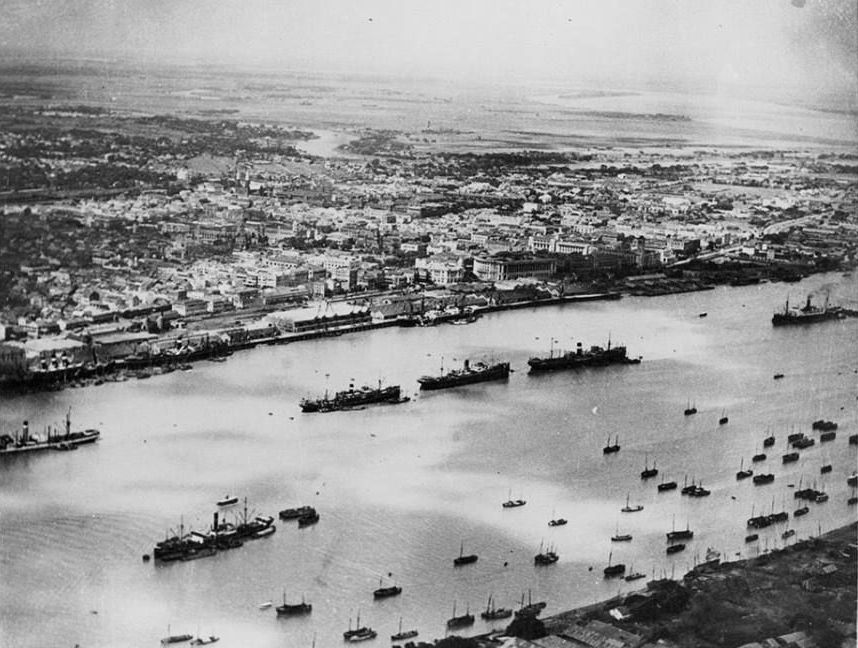
But Rangoon's importance extended beyond its role as a logistics hub. The city housed critical oil refineries, served as a major commercial center, and represented British colonial power in Southeast Asia. Its capture would provide Japan with a strategic bulwark to defend its conquests in Malaya and the Dutch East Indies while opening a potential invasion route toward India itself. The city was ripe for the taking—poorly defended, with inadequate air cover and a garrison unprepared for the fury that was about to descend upon them.
December 23, 1941: The First Blow
The morning of December 23, 1941, dawned like any other in Rangoon. The city's bustling markets were filled with vendors—Burmese women seated behind their stalls of dried fish and betel nuts, their cheroots clenched between painted lips. Coolies sweated beneath heavy burdens on the quays along the Strand Road. British merchants conducted business in their gracious bungalows. Few imagined that within hours, their world would be consumed by fire and death.
At his headquarters in Bangkok, Lieutenant General Michio Sugawara of the Imperial Japanese Army Air Service's 3rd Flying Division (Hikoshidan) had finalized plans for a massive aerial assault. Sugawara, an experienced commander who would later lead the Third Air Army throughout Southeast Asia, assembled a formidable striking force: approximately 80 bombers supported by 30 fighters, representing one of the largest Japanese air operations of the war's opening weeks.

The backbone of this aerial armada consisted of twin-engine Mitsubishi Ki-21 heavy bombers, known by their Allied reporting name "Sally". These modern aircraft, carrying crews of five to seven men, could fly at 300 miles per hour and deliver devastating bomb loads. They were supported by lighter Mitsubishi Ki-30 bombers (code-named "Ann"), each capable of carrying a 600-pound bomb, and nimble Nakajima Ki-27 fighters (Type 97, or "Nate") providing escort.
The Japanese planners had selected their targets with calculated precision. The primary objectives were Mingaladon airfield—the main Allied air base located just outside the capital—and the densely populated downtown districts of Rangoon. The strategy reflected the prevailing airpower theories of the era: that terror bombing of civilian populations would shatter morale, create panic and chaos, and force the people to turn against their colonial leaders. To aid navigation across the 400 miles from their Thai bases, Japanese pilots would use the gleaming golden dome of the Shwedagon Pagoda as an unmistakable landmark visible for miles.
The Attack Unfolds
As the Japanese formation approached Rangoon in the late morning, the city's woefully inadequate defenses scrambled to respond. At Mingaladon airfield, the defenders could muster only 16 Royal Air Force Brewster Buffalo fighters from No. 67 Squadron and approximately 16 Curtiss P-40 Tomahawks of the American Volunteer Group's 3rd Squadron, the "Hell's Angels".
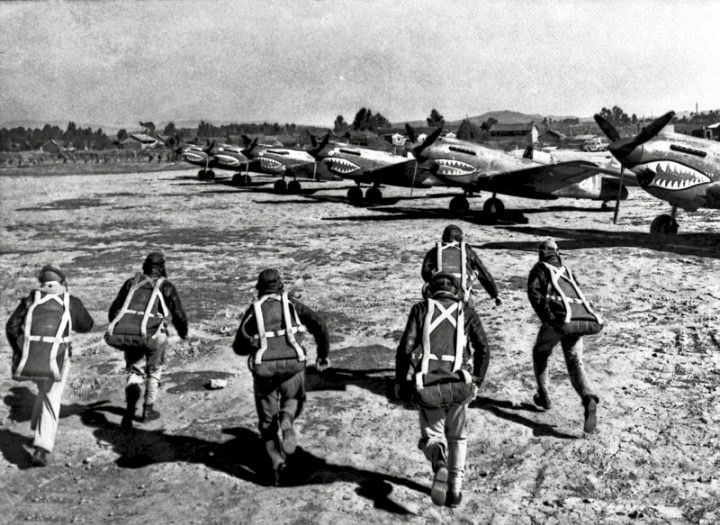
The Buffaloes were outclassed aircraft, deemed inadequate for combat against German fighters in Europe and shipped to the Far East where military planners naively believed they would prove sufficient against Japanese opposition. The AVG pilots, by contrast, flew the more capable P-40 Tomahawk—rugged fighters that, while less maneuverable than their Japanese opponents, possessed superior speed, firepower, and diving capability.
A couple of Buffalo fighters already airborne were the first to intercept the Japanese bomber stream heading toward Mingaladon. Soon, a squadron of Tomahawks managed to gain sufficient altitude to join the engagement. The American pilots, applying the revolutionary tactics developed by their commander Claire Lee Chennault, eschewed traditional dogfighting maneuvers in favor of high-speed "boom-and-zoom" attacks—diving through the Japanese formations with guns blazing, then using their superior speed to climb away before the nimble enemy fighters could respond.
Pilot Chuck Older forced one Ki-21 out of formation, trailing smoke. Another bomber crashed near the waterfront. The aerial battle raged as waves of Japanese aircraft attacked both the airfield and the city center. At Mingaladon, bombs cratered the runway, destroyed the operations room, and killed 17 Allied military personnel. Multiple aircraft were destroyed on the ground in the initial assault.

But it was in Rangoon's downtown districts where the true horror unfolded. The Japanese bombers dropped a lethal combination of high-explosive and incendiary bombs on the densely packed residential and commercial areas behind the docks. The wooden buildings that comprised much of the city's architecture proved devastatingly vulnerable. Over three-fifths of these structures were destroyed by fire and blast, creating an inferno that swept through entire neighborhoods.
The carnage was unimaginable. Contemporary accounts describe scenes of pure chaos: flying glass from shattered windows cutting down fleeing civilians, collapsing buildings crushing those trapped inside, and panicked crowds trampling over the fallen in their desperate attempts to escape the bombardment. An Indian shopkeeper later recounted the heartbreak of seeing women and children crying and running in terror, with small children clinging to strangers they mistook for their parents in the smoke and confusion.

The casualty figures remain disputed, but all accounts agree they were catastrophic. Allied records estimated between 1,000 and 2,000 civilians were killed in that first raid alone. The Royal Air Force's official history recorded approximately 2,000 dead. Some sources suggest the true number may have been even higher. The docks—critical to the city's function as a supply port—were severely damaged, and crucially, thousands of dock workers fled the city in terror, crippling Rangoon's ability to offload the ships filled with essential war supplies sitting in the harbor.
The Aerial Battle: Claims vs. Reality
In the confusion and adrenaline of aerial combat, both sides wildly overestimated their success. Japanese pilots later claimed to have shot down numerous Allied fighters, but these claims bore little resemblance to reality—a pattern that would continue throughout the Burma campaign. The Allied pilots were equally guilty of inflated victory claims, though their exaggerations were often driven by the genuine difficulty of confirming kills in the chaos of multi-aircraft engagements.

Japanese records later revealed that seven bombers were shot down during the December 23 attack, with an eighth crashing on its return journey. The Allied forces lost four Tomahawks, with two American pilots killed in action. No Buffalo fighters were lost in this engagement, though the type would soon prove its inadequacy and be replaced by Hawker Hurricanes by February 1942.
Christmas Day: The Second Apocalypse
If the residents of Rangoon hoped that the December 23 attack was an isolated incident, their hopes were brutally crushed on Christmas Day. General Sugawara, reportedly angered by the losses his bomber units had sustained and initially planning to strike again on December 24, delayed the second major raid until December 25. This timing—attacking on one of Christianity's most sacred holidays—added a particularly cruel psychological dimension to the assault.
On Christmas morning, as what remained of Rangoon's Christian community attempted to celebrate the holiday, an even larger Japanese force appeared over the city: more than 100 aircraft in a coordinated assault. The RAF reported that the Christmas Day raid killed an estimated 5,000 additional civilians. Field Marshal Archibald Wavell, Commander-in-Chief of India Command and soon to lead the short-lived ABDACOM (American-British-Dutch-Australian Command), happened to arrive at Rangoon by aircraft on December 25, landing amid the Japanese air raid—a harrowing introduction to the Burma theater.

The Japanese fighters on this raid were led by the 64th Air Combat Group under Major Tateo Kato, an ace pilot whose unit would become one of the most feared fighter squadrons in the Burma campaign. Once again, the Flying Tigers and RAF pilots scrambled to intercept, and once again, fierce air combat raged over the burning city. American sources claimed the AVG shot down 35 enemy aircraft on this date, though as with most air combat claims from this period, the actual Japanese losses were far lower.
The Human Exodus
The psychological impact of these two massive raids in quick succession proved as devastating as the physical destruction. The attacks shattered whatever confidence Rangoon's population had in British protection and triggered a mass evacuation that would cripple the city's ability to function.
The Indian population of Rangoon—who comprised the vast majority of the city's working class—led the exodus. Already wary after anti-Indian riots in the previous decade and perceiving (correctly) that the British were preparing to abandon Burma, Indians began fleeing northward en masse. The dock workers abandoned their posts first, leaving ships full of critical war supplies sitting in the harbor as sitting targets for subsequent Japanese raids. Public transport ground to a halt. Essential services collapsed.

What followed was one of the war's great humanitarian disasters, though one that remains largely forgotten in popular memory of World War II. The evacuation was marked by racial discrimination, with British and Anglo-Burmese civilians given priority access to ships and vehicles while Indian evacuees were often denied passage. Tens of thousands would attempt to reach India by various overland routes—some heading to Prome and then over the Taungup Pass toward Chittagong, others trekking through the nightmarish terrain of northern Burma toward Manipur.
A personal account preserved in oral history archives captures the horror of this exodus. Hardeep Singh, who was a child at the time, recalled his family joining thousands of others on a month-long trek through dense jungle: "I was just a child, but I remember details vividly... Many perished along the way". Contemporary witnesses described seeing bodies along the roadsides, bridges collapsing under the weight of refugees, and boats capsizing with their human cargo.
The Defenders: Underdogs Against the Rising Sun
The Allied air defenses that faced the Japanese onslaught in December 1941 were pitifully inadequate for the task at hand. No. 67 Squadron RAF, equipped with Buffalo fighters, had only reached full strength in late 1941 and transferred from Malaya to Burma just two months before the Japanese attacks began. The Buffalo, with its short range and inferior performance, proved to be exactly the wrong aircraft for the mission—though its pilots fought with courage and determination despite their equipment's shortcomings.
The American Volunteer Group represented a different story—one of innovation and tactical genius overcoming material disadvantages. The AVG had been created through a complex semi-covert arrangement authorized by President Franklin D. Roosevelt in April 1941. Under the leadership of Claire Lee Chennault—a retired U.S. Army Air Corps officer whose innovative tactical theories had been dismissed by his superiors—American military pilots from the Army, Navy, and Marine Corps "resigned" from their services to become "civilian" contractors in the employ of the Chinese government.

Chennault was a visionary who recognized that his pilots would always be outnumbered and that their P-40 fighters, while tough and well-armed, could not out-turn the lightweight Japanese fighters in traditional dogfighting maneuvers. Instead, he drilled his pilots relentlessly in tactics that exploited the P-40's strengths: superior speed, heavier armament, better pilot protection, and excellent diving characteristics.
"You can count on a higher top speed, faster dive, and superior firepower," Chennault lectured his pilots daily during their training at Toungoo. "They can turn on a dime and climb almost straight up. If they can get you into a turning combat, they are deadly". His solution was revolutionary: maintain altitude advantage, dive through enemy formations in slashing attacks, use superior speed to disengage, and never, ever try to dogfight a Zero or a Nate.
This tactical doctrine, eventually adopted by U.S. Army Air Forces units throughout the Pacific, gave the outnumbered Flying Tigers a fighting chance. Over their seven-month existence (December 1941 to July 1942), the AVG would claim 296 enemy aircraft destroyed for the loss of only four pilots killed in air-to-air combat—a kill ratio that seemed almost impossible. While these claims were certainly inflated (as were all air combat victory claims of the era), the Flying Tigers' success in defending targets with inferior numbers was undeniable.
Chennault also possessed another crucial advantage: an extensive early-warning network he described as "a vast spider net of people, radios, telephones, and telegraph lines that covered all of Free China accessible to enemy aircraft". This intelligence system, built with Chinese assistance over years, gave his pilots precious time to scramble and gain altitude before Japanese bombers arrived—a decisive edge in an era before radar became widespread.
The Japanese Perspective
Understanding the Japanese side of this campaign requires examining the capabilities and limitations of their aircraft and the strategic thinking that drove their operations. The Mitsubishi Ki-21, which formed the backbone of the bomber force attacking Rangoon, was a modern and capable heavy bomber when it first entered service in 1938. With a crew of five to seven, a top speed of 400 km/h, and the ability to carry 750 kg of bombs with a range of five hours, it compared favorably to most twin-engine bombers of the mid-1930s.
However, the Ki-21 had significant weaknesses that became apparent when facing modern fighters. Its defensive armament was light (initially only five 7.7mm machine guns), and it lacked self-sealing fuel tanks and armor protection for the crew—deficiencies that would prove costly when facing P-40s and Hurricanes armed with heavy .50 caliber machine guns. By early 1942, Ki-21 units were suffering severe casualties in Burma, forcing the Japanese to introduce improved variants and eventually to rely more heavily on fighter sweeps to suppress Allied air defenses.
The lighter Mitsubishi Ki-30, which also participated in the Rangoon raids, carried a smaller 300-450 kg bomb load but was valued for its reliability and ability to operate from rough field conditions. Like the Ki-21, it proved vulnerable to modern fighters once the Japanese lost air superiority, and by 1942 many were relegated to secondary roles.
The Broader Campaign: From December 1941 to March 1942
The December bombings were merely the opening acts of a sustained air campaign that would continue until March 1942. Throughout January and February, Japanese bombers conducted repeated raids on Rangoon and other targets in Burma, gradually wearing down the outnumbered Allied air forces. On January 23-24, 1942, Japanese aircraft attacked Rangoon on consecutive days as their ground forces advanced through southern Burma, capturing Tavoy and Moulmein.
The Allied air forces, vastly outnumbered by the Imperial Japanese Army Air Force, contested the skies of southern Burma from Mingaladon throughout the winter of 1941-42. RAF No. 17 Squadron arrived in January 1942 with Hawker Hurricane fighters to reinforce the defense, but by then the strategic situation had become hopeless. The rapid advance of Japanese ground forces—elements of the 15th Army's 33rd and 55th Divisions—made the defense of Rangoon increasingly untenable.
By late February 1942, the British decision to evacuate Rangoon had been made. On March 7-8, 1942, in a desperate and chaotic withdrawal, British, Indian, and Commonwealth forces abandoned the capital after implementing a scorched-earth policy that saw the destruction of the port facilities, oil refineries, and other infrastructure that might prove useful to the Japanese. The Japanese occupied Rangoon on March 8, 1942, finding a city already largely abandoned and partially destroyed. The Long Shadow: Impact and Legacy
The bombing of Rangoon in December 1941 marked the beginning of one of World War II's longest and most brutal campaigns. Over the next three and a half years, Burma would witness sustained fighting as Japanese forces occupied the country, exploited its resources, and used it as a base for operations against India and China. The Allied reconquest, finally achieved in 1945, came at enormous cost to all sides.
For the civilian population of Burma—particularly the Indian community—the December bombings initiated a catastrophe from which many never recovered. Estimates suggest that between 100,000 and 500,000 refugees died during the various evacuations and treks to India in 1942, victims of disease, starvation, Japanese strafing attacks, and the brutal environment. This humanitarian disaster remained largely hidden from public consciousness, overshadowed by the more famous military campaigns of the war.
The tactical lessons learned in the skies over Rangoon—particularly Chennault's boom-and-zoom tactics—would be refined and adopted by Allied air forces throughout the Pacific theater. The Flying Tigers' success demonstrated that even inferior numbers could achieve results when proper tactics were employed and pilot training was emphasized. These lessons would prove crucial as America built the massive air forces that would eventually dominate the Pacific skies.
For the people of Burma, the bombings marked the collapse of British colonial authority and the beginning of a brutal Japanese occupation that would last until 1945. The experience of the war years would profoundly shape Burma's post-war trajectory, contributing to a fierce independence movement that would see the country break free from British control in 1948—though at the cost of plunging almost immediately into civil war.


Comments