Mindat, The Phoenix of the Chin Hills: from the Tumee Revolution of 2021 to the Liberation of 2024

The hero of my novel, Awm Awi (aka Khin Yadanar) is a doctor in the Chin Defense Force Mindat. Her parents died during the Battle of Mindat in 2021, following the military coup, and she joined the armed resistance to liberate her hometown, Mindat, the first city to openly rebel against the junta.

Introduction
The mist that clings to the Chin Hills has always hidden stories of resilience, but none quite as piercing as the saga of Mindat. Today, in December 2025, the air in this mountain town feels different. It is thinner, perhaps, stripped of the heavy smoke of artillery that choked it for so long. It is the air of freedom: fragile, cold, but undeniable as we celebrate the first anniversary of the liberation of Mindat.
For nearly four years, Mindat was the open wound of the Chin resistance. It was here, in April 2021, that the first sparks of armed defiance against the military coup ignited. And it was here, just one year ago in December 2024, that the tide decisively turned.
As we look back from the vantage point of December 2025, the story of Mindat is not just a chronicle of battle; it is a testament to the unbreakable spirit of a people who faced fighter jets with hunting rifles and won.
The Tumee Revolution: April 2021
To understand the liberation of 2024, one must return to the heartbreak of 2021. In the wake of the February coup, while much of the world watched with bated breath, the people of Mindat acted.
They called it the "Tumee Revolution."

When the Tatmadaw rolled into town to crush the peaceful protests, the young men and women of Mindat did not have RPGs or automatic rifles. They had Tumee—traditional, muzzle-loading hunting rifles used by their forefathers. These were muskets, essentially, effective only at close range and requiring agonizing seconds to reload.
Against them stood a modern army equipped with sniper rifles, heavy artillery, and air support. The disparity was comical to military strategists but terrifyingly real to the fighters of the newly formed Chinland Defense Force (CDF).

For weeks in April and May 2021, the CDF-Mindat held the town. They used their knowledge of the steep, winding terrain to ambush convoys. They turned the geography of the Chin Hills into a fortress. The bravery of those days is etched into local legend—stories of teenagers holding ridgelines against battalions, fueled by nothing but adrenaline and the absolute refusal to bow to tyranny.
But courage cannot intercept artillery shells. The Tatmadaw responded with characteristic brutality. They cut off the town's water supply, a war crime designed to break the civilian population. They declared martial law and began indiscriminate shelling of residential areas. Snipers were positioned on the hills, treating the streets as a shooting gallery.
In mid-May 2021, the CDF leadership made the most painful decision of the war: they retreated. To save the civilians from a massacre, they melted back into the jungles, leaving their beloved town to the occupation. It was not a surrender; it was a promise to return.
The Long Night of Occupation
For over three years, Mindat endured a suffocating occupation. The Tatmadaw turned the town into a garrison. Schools became barracks; churches became interrogation centers.

The exactions committed during this period were systematic and cruel. Reports from human rights groups detailed the military’s use of "human shields"—forcing civilians to walk ahead of columns to detonate landmines or deter ambushes. The sacred places of the Chin people were desecrated. The junta forces looted homes, stripped the hospital of supplies, and established a reign of terror where any suspected sympathy for the resistance could lead to disappearance.

The town, once a vibrant hub of Chin culture, became a ghost town. Thousands fled to the forests or across the border to India, living in makeshift camps where monsoon rains and disease took their own toll. But in the jungle, the resistance did not die. It evolved. The Tumee rifles were replaced by captured modern weapons. The loose bands of volunteers hardened into a disciplined fighting force.
The Return: December 2024
The promise made in 2021 was kept in December 2024.
The liberation of Mindat was not an isolated event but the crescendo of a meticulously planned offensive known as Operation Chin Brotherhood. By late 2024, the military junta was overstretched, facing coordinated attacks across the country. In the west, the Arakan Army (AA) had launched a massive offensive in neighboring Rakhine State, besieging the Western Command headquarters in Ann.
Sensing the regime's weakness, the Chin Brotherhood Alliance, supported by allies from the AA, descended on Mindat.
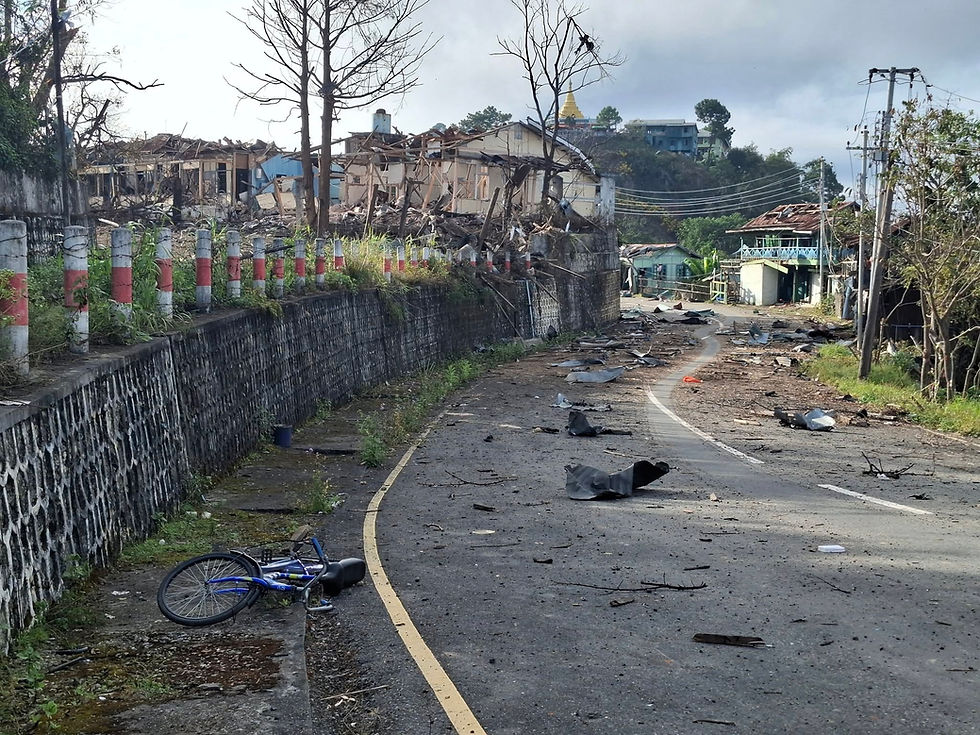
The battle was fierce but decisive. On December 22, 2024, resistance forces stormed the key junta strongholds within the town. The regime soldiers had entrenched themselves in the very heart of the community—occupying the district hospital and the central police station, using them as bunkers in a flagrant violation of international law.
The liberation forces had to clear these positions room by room. Unlike the retreat of 2021, there was no hesitation. The junta troops, demoralized and cut off from reinforcements, crumbled. By Christmas 2024, the flag of the Chin resistance flew over Mindat once more.
The Scars of Departure
The Tatmadaw rarely leaves a city intact, and Mindat was no exception. Before their final collapse and retreat, the occupying forces enacted a "scorched earth" policy.
As the perimeter broke, regime soldiers sabotaged essential infrastructure. The district hospital, which they had used as a fortress, was left ransacked, its equipment smashed or stolen. Public administration buildings were torched to prevent the incoming administration from functioning.
Picture gallery: click on the arrows to see all pictures
But the most insidious legacy they left behind was not fire, but metal. In their wake, the retreating army sowed the town with landmines. They mined the entryways to homes, the paths to the fields, and the surroundings of the churches they had defiled. The destruction was designed to punish the people for their liberation, to make the return home as dangerous as the war itself.
Chin State Today: December 2025
One year has passed since that historic December. As we stand at the end of 2025, the situation in Chin State is one of precarious triumph.
The Map of Freedom
The resistance now controls approximately 80% of Chin State. The liberation of Mindat was followed by a domino effect. Falam fell to resistance forces in April 2025, and the southern township of Paletwa remains firmly under the control of the Arakan Army, a critical—if complex—ally. The junta is largely confined to the state capital, Hakha, which remains a besieged island of regime control, and a few isolated outposts that rely entirely on aerial resupply.

The Challenge of Unity
However, peace has not fully returned. The removal of the common enemy has laid bare internal fractures. The resistance is currently navigating a delicate power struggle between the Chinland Council (led by the veteran Chin National Front) and the Chin Brotherhood Alliance (which spearheaded the liberation of Mindat).
Tensions have flared over the administration of liberated territories and the role of the Arakan Army in Chin affairs. There have been sporadic clashes between these factions, a heartbreaking development for a people who have bled together for so long. The "Free Chinland" is a reality, but its political future is still being written, often with heated rhetoric.
The Looming Threat
Militarily, the war is not over. The junta, desperate to stage "sham elections" to legitimize its rule, has launched renewed counter-offensives in late 2025. While their ground troops are demoralized, their air power remains a deadly threat. Airstrikes continue to terrorize liberated villages, and the sound of a jet engine still sends children running for bunkers.
Yet, despite the ruins, the mines, and the political friction, there is hope in Mindat this December. Families are rebuilding their homes on the ashes of the old. The church bells, silent for three years, are ringing again.
The Battle of Mindat in 2021 showed the world that the people of Myanmar would not submit. The Liberation of 2024 proved that they could win. Now, in 2025, the challenge is no longer just about fighting; it is about building a nation worthy of the courage that saved it.
The Tumee rifles have been retired, hung on walls as relics of glory. But the spirit that loaded them—that fierce, stubborn love for freedom—remains the most powerful weapon in the Chin Hills.


Comments